On this page
Identify what pays the money back
Short-term finance can bridge a gap between paying a bill and collecting revenue. It becomes harder to justify when the business needs another loan to repay the first. Before choosing a product, write down the amount needed, when it leaves the account and the specific cash receipt expected to repay it.
For example, a confirmed customer invoice creates a different funding question from buying stock for sales that have not happened yet. Both carry risk, but the second depends on a sales forecast as well as payment timing.
Compare the main routes
On a small screen, scroll the table sideways to see every column.
| Option | How it may fit | What can make it a poor fit |
|---|---|---|
| Short-term business loan | A defined expense with a repayment schedule the business can meet. | Frequent repayments begin before the funded activity produces cash. |
| Line of credit or overdraft | Repeated cash gaps where access to a limit matters more than receiving the whole amount at once. | Ongoing facility fees, review conditions or a balance that never falls. |
| Invoice finance | Cash tied up in eligible customer invoices. | Disputed invoices, excluded customers or terms that leave the business carrying collection risk. |
| Supplier terms or customer deposits | Moving payment dates closer together without a separate loan. | Lost discounts, higher prices or commitments the business cannot deliver. |
The Australian Government's funding guide explains the broader choices. Availability depends on the business and the provider; a category is not an approval promise.
A fixed loan and a reusable limit solve different problems
A term loan releases an agreed amount with a repayment schedule. It can suit a one-off purchase where the business knows the amount and can service the payments from ordinary trading. It is less convenient when the amount needed changes each week: drawing too much adds debt, while drawing too little may lead to a second application.
A line of credit or overdraft can provide access to a limit for repeated gaps. Compare interest on the amount used with facility, line or other charges that may apply even when little is drawn. Read the review and withdrawal conditions. Access to a limit today is not a promise that it will remain unchanged indefinitely.
Invoice finance starts with eligible receivables rather than an unmade sale. Ask which invoices count, what proportion is advanced, when the balance is released and who bears the loss if the debtor does not pay. A large invoice list is less useful if the provider excludes the customers responsible for most of it.
For stock bought repeatedly, supplier terms deserve a separate comparison. A later payment date can align the outflow with receipts, but the supplier may change the price or remove an early-payment discount. The government's funding guide includes trade credit among the available routes. Ask for the actual price and dates rather than assuming the absence of a lender means the finance is free.
Calculate the amount usable on day one
Suppose an illustrative $40,000 loan deducts an $800 establishment fee and requires 12 monthly payments of $3,700. The account receives $39,200, while scheduled repayments total $44,400. The difference is $5,200. If the supplier needs $40,000, that offer leaves an immediate $800 shortfall despite the nominal loan amount.
This example is deliberately stated in cash amounts because a quoted rate alone can obscure deductions. It is not a market quote or an annualised rate calculation. Ask the provider to reconcile every amount between the approved limit, the payment to your account and the repayment schedule.
Include costs that arise from executing the project as well as obtaining finance. Freight, installation, insurance or wages before an order is delivered can create a separate cash need. Avoid counting the same contingency twice, but do not commit to the supplier until the complete first-stage funding is available.
Test liquidity week by week
Monthly profitability can conceal a bad week. In a simple illustration, a business has an $8,000 unrestricted buffer and expects a customer payment in six weeks. Proposed loan debits are $900 weekly. The first six debits use $5,400, leaving $2,600 before any other unexpected costs. A further three-week delay requires $2,700 and exhausts the buffer.
That result does not prove the whole project loses money. It shows that the proposed payment pattern fails before the expected income arrives. A later first payment, smaller commitment, different product or customer deposit could change the position, if actually available. Substituting a larger loan without checking its added repayments can make the problem worse.
Include existing finance in the same weekly schedule. Each lender's instalment may look manageable by itself while the combined debits compete with payroll. Use funds that are genuinely available to the business; tax reserves and money already committed to suppliers should not quietly become the emergency repayment buffer.
Do not build the exit around an unapproved refinance
A short-term facility can be expensive if it remains in place through repeated renewals. Ask what must happen for the balance to fall and identify that event in the forecast. If the plan is simply to obtain another loan later, the business is relying on a future approval, future pricing and continued access to finance.
Request a payout figure for the date you expect to finish using the money. With some fee structures, repaying early does not remove the whole remaining charge. Compare that figure with the cost of a facility priced for a longer but more realistic period. A slightly longer stated term can be preferable to a short contract that depends on an uncertain renewal.
Bring evidence that explains the gap
Prepare the relevant invoice, purchase order, supplier quote or stock plan together with bank statements, current accounts and existing debt commitments. Explain why the gap has arisen and what will close it. Lenders set their own requirements, but this evidence also helps you identify assumptions that remain untested.
If the gap reflects trading losses rather than timing, revisit prices, costs and the scale of the commitment. The government cash-flow guide provides a structured review. More borrowing deserves a specific recovery case, not just confidence that a busy period will arrive.
Price the gap you actually have
Ask for the funds received after deductions, every scheduled payment, all mandatory fees and the total payable. Confirm how early repayment works. A short term does not necessarily mean a small cost, and a smaller regular payment may come from extending the debt.
Compare quotes on the same amount and expected time in use. Our interest-rate guide explains why flat rates, reducing-balance rates and fixed fees need different treatment.
Test a late receipt before signing
Move the expected customer payment back in your cash-flow forecast and check whether wages, tax, rent and the loan payments still fit. Use a delay that is plausible for that customer or industry. If the forecast fails immediately, reduce the commitment or address the payment terms before relying on the finance.
Also read the security, personal-guarantee, default and refinancing terms. An unsecured product can still involve obligations beyond the business's ordinary cash flow; ask the provider to explain the actual contract.
A 45-day customer payment can arrive after several repayments
If wages and supplier bills leave the account now but a customer pays in 45 days, plot every finance debit before that receipt. Then move the receipt back another fortnight. The quoted instalment may look manageable in isolation while the combined cash schedule does not. These timings are an example, not a forecast for a particular customer.
When the gap is recurring
If each month ends with the same shortage, investigate margins, stock turnover, debtor collection and fixed expenses. Borrowing can delay the pressure without resolving it. The next useful step may be a cash-flow review with your accountant rather than a larger facility.
Why an old Captrove review is not a current quote
An old Captrove product profile is not a current short-term loan quote. Earlier references to a COVID-era suspension do not establish today’s operating status, and reviews of another Credit Corp product do not measure Captrove borrowing. Existing customers should identify the creditor on their agreement. For new funding, compare net cash, every repayment and payout at the intended exit date using a current named offer.
How the repayment illustration is calculated
The fee-free monthly payments on $50,000 over 24 months are $2,244.53 at 7.26% and $2,353.67 at 12%. Using unrounded payments, the difference in total interest is $2,619.52, or about $2,619. Multiplying the rounded whole-dollar labels gives a different result. These are SMBLoan calculations, not RBA repayment estimates. The 7.26% assumption is the RBA May 2026 historical average; 12% is a hypothetical alternative. Neither is a current offer.
For the latest dated benchmark, use the loan-rate study. An average cannot establish the price or availability of a short-term unsecured facility.
Short term does not mean small cost
A 12% scenario costs about $2,619 more than 7.26% on $50,000 over two years
Short term finance is often sold on speed and a manageable repayment amount. Put the offer beside a common benchmark using the same amount and term. The comparison shows the cost effect of the two assumed rates. It does not establish why a lender prices a particular offer differently.
Download the one page visual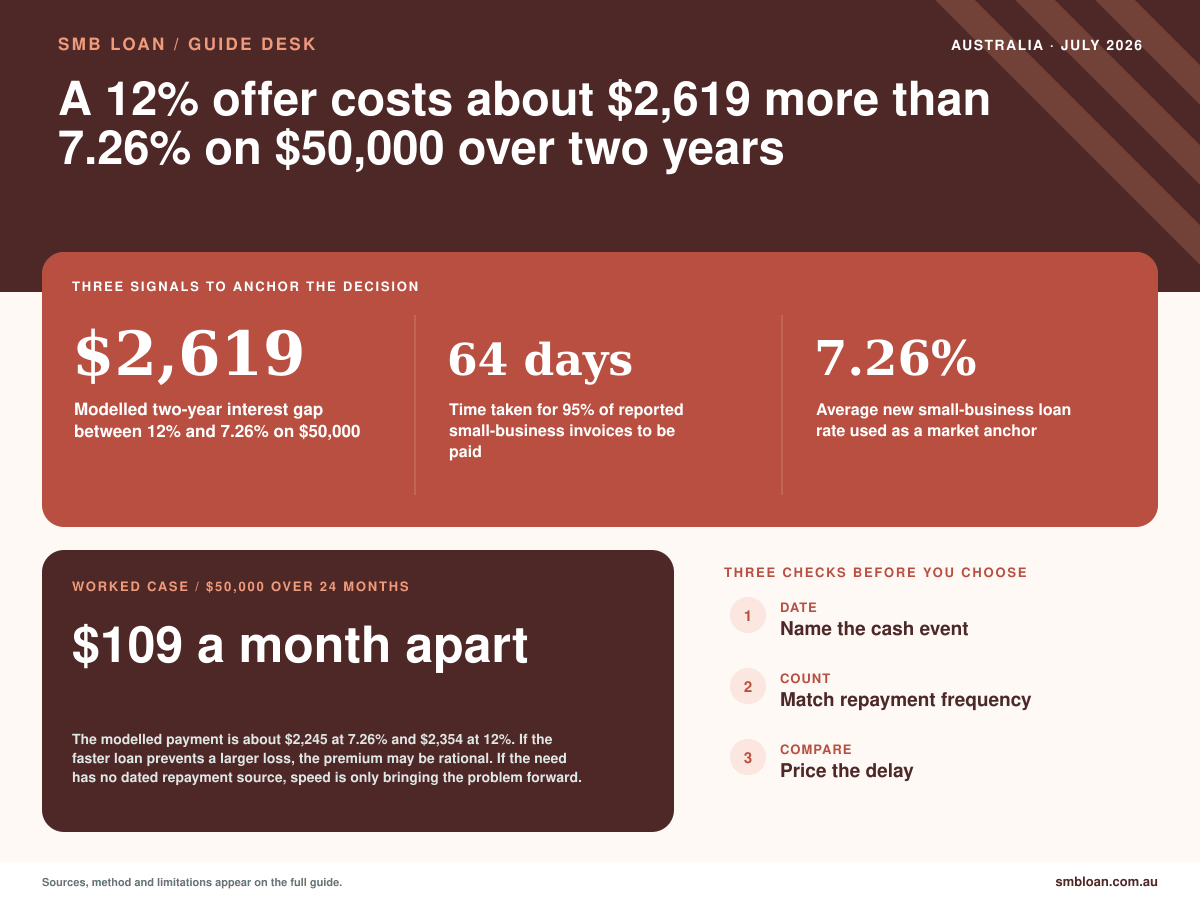
Evidence behind the visual
- $2,619Modelled two year interest gap between 12% and 7.26% on $50,000SMB Loan repayment model ↗
- 64 daysTime taken for 95% of reported small business invoices to be paidPayment Times Regulator, January 2026 ↗
- 7.26%Average new small business loan rate used as a market anchorRBA business lending rates, May 2026 ↗
Worked cost example
$50,000 over 24 months
$109 a month apartThe modelled payment is about $2,245 at 7.26% and $2,354 at 12%. If the faster loan prevents a larger loss, the premium may be rational. If the need has no dated repayment source, speed is only bringing the problem forward.
Illustration only. Monthly amortisation; fees excluded.Three checks before acting
- 1DateName the cash event
Identify the invoice, stock turn or contract payment that clears the debt.
- 2CountMatch repayment frequency
Weekly debits can create pressure hidden by a monthly comparison.
- 3ComparePrice the delay
Set the finance premium against the real cost of waiting for cheaper money.
What the figures mean
Short term funding can solve a dated timing problem. It is poor structural capital when the business needs repeated refinancing or cannot point to the cash event that repays it.
Limits of this comparison: The model uses a conventional annual percentage rate. Factor rates and fixed fee products need a separate cash flow calculation.